


By 2 p.m., your shoulders are already up near your ears
You didn't notice it happening. You were focused on a call, or a deadline, or just the slow grind of back-to-back emails — and somewhere between 10 a.m. and lunch, your shoulders crept upward, your neck stiffened, and the dull ache that usually greets you at 7 p.m. showed up four hours early.
Most advice about neck and shoulder tension is written for the end of the day. Hot shower, stretch, go to bed. But if you work from home or spend long hours at a desk, the tension isn't waiting politely until you clock out. It compounds in real time, layer by layer, until by evening you're too worn down to actually do anything about it.
The better move is a midday reset — a deliberate 10-to-15-minute pause that interrupts the tension cycle before it takes over the rest of your day. Here's what that actually looks like.
Step 1: Stop and take stock of where you're holding it
Before you do anything else, just notice. Sit back from your keyboard and do a quick scan from your jaw down to your shoulders. Is your jaw clenched? Are your shoulders raised? Is your chin jutting forward toward the screen?
Most people are surprised by what they find. The jaw and the upper trapezius muscles are where desk workers carry stress first — and they're often tight for hours before you consciously register any discomfort. Naming what's tight is the first step to releasing it.
Take three slow breaths here, letting your shoulders drop on each exhale. It sounds almost too simple, but a conscious exhale physically signals your nervous system to ease out of the guarded posture you've been holding. Don't skip this part.
Step 2: A posture reset that actually sticks (for a while)
Posture advice usually goes in one ear and out the other because it's too vague. "Sit up straight" doesn't tell you what to do with your hips, your screen height, or the fact that your chair is slightly too low.
Here's a more concrete version: sit with your hips pushed back to the rear of the chair, feet flat on the floor. Roll your shoulders back and down — not in an exaggerated military way, just enough to open your chest. Then gently tuck your chin back, as if making a very slight double chin. That last cue is the one most people miss, and it's what actually takes pressure off the base of your skull and upper neck.
You won't hold this position perfectly for the rest of the afternoon. Nobody does. But resetting it now gives your muscles a brief reprieve and a reminder of where neutral actually is.
Step 3: Apply warmth to the places that need it most
Heat is one of the most effective tools for breaking the tension-pain cycle in muscles — it increases blood flow, softens the tissue, and makes it easier for the muscle to actually let go. The problem is that most heat options are inconvenient at a desk: heating pads need an outlet, hot water bottles are messy, and a hot shower is obviously not an option mid-meeting.
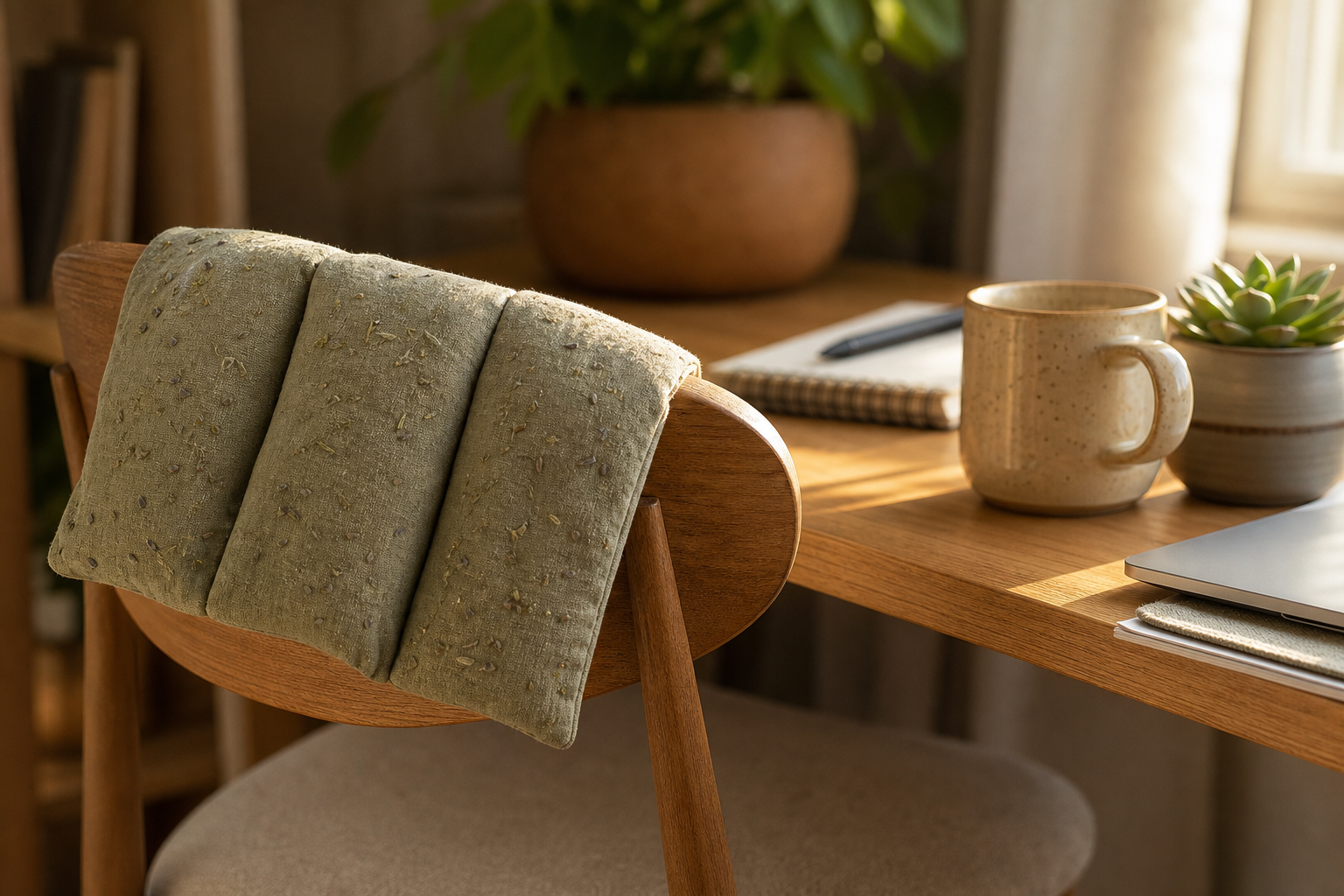
This is exactly where a microwave-heated herbal wrap earns its place in a desk setup. A neck or shoulder wrap — like the Kozi Soothing Neck Wrap — can be warmed in minutes and draped over your shoulders or around your neck while you eat lunch, read, or just sit quietly. The weight of it alone has a grounding, calming effect, and the gentle heat works on the muscle tissue without requiring you to stop what you're doing entirely.
Even ten minutes of warmth applied during a lunch break can meaningfully interrupt the tension that's been building all morning. Think of it less as a spa treatment and more as a practical maintenance tool — the same way you'd charge your phone before the battery hits zero.
Step 4: A few targeted movements — no yoga mat required
You don't need a stretching routine. You need three or four movements that address the specific areas desk work compresses.
- Neck side stretch: Drop your right ear toward your right shoulder, hold for a breath or two, then switch. That's it. No forcing, no bouncing.
- Shoulder rolls: Roll your shoulders backward in slow, full circles — five or six times. Forward rolls feel satisfying but actually reinforce the hunched posture; backward is the direction that opens things up.
- Chest opener: Clasp your hands behind your back (or behind the chair back), gently squeeze your shoulder blades together, and lift your chest. Hold for a few breaths. This counteracts hours of reaching forward toward a keyboard.
- Upper trap release: Place your right hand on your left shoulder and apply gentle downward pressure while slowly tilting your head to the right. You'll feel this in the muscle that runs from your neck to your shoulder — exactly where most desk tension lives.
Do these while the warmth is still on your neck and shoulders and you'll get noticeably more range of motion out of each movement. Heat and gentle stretching work better together than either does alone.
Step 5: Don't immediately go back to the same position
The reset only works if you give it a moment to land. After the stretches, sit quietly for two or three minutes — eat something, look out a window, let your eyes rest somewhere that isn't a screen. If eye fatigue is part of your midday slump, a cooled eye mask can do a lot in just a few minutes; it's worth understanding why your eyes feel so exhausted by evening and addressing it before it gets to that point.
The goal isn't perfection — it's interruption. Breaking the tension cycle once in the middle of the day changes how you feel at 5 p.m., which changes how you sleep, which changes how you feel the next morning. It compounds in the other direction.
Make it a non-negotiable, not a nice-to-have
The reason most people don't do this is that it feels optional. There's always something more urgent than a 12-minute break. But the tension you're ignoring now is the headache you'll have by 4 p.m. and the poor sleep you'll have tonight. Framed that way, the midday reset isn't a luxury — it's just sensible maintenance.
Keep what you need within arm's reach. If your herbal wrap is buried in a closet, you won't use it. If it's sitting on your desk or on a shelf nearby, you will. Friction is the enemy of good habits, and convenience is their best friend.
A Kozi neck or shoulder wrap kept at your desk makes this whole routine easier to actually do — not just to intend to do. Browse the neck and shoulder collection at koziwellness.com and find the one that fits your workday.
Frequently Asked Questions
How often should I do a midday tension reset?
Once a day during your lunch break is a good starting point, but even a quick posture check and a few shoulder rolls every couple of hours can help prevent tension from accumulating. The key is consistency — a short reset done daily beats a long one done occasionally.
Is heat or cold better for neck and shoulder tension from desk work?
For the kind of chronic, low-grade muscle tension that builds up during desk work, warmth is generally more helpful — it relaxes tight muscles and improves circulation in the area. Cold therapy is typically more useful for acute injuries or inflammation. If you're dealing with a specific injury, check with a healthcare provider about what's right for your situation.
Can an herbal neck wrap really make a difference in just 10 minutes?
For many people, yes — especially when combined with intentional breathing and light stretching. The warmth helps the muscle tissue relax more readily, so even a short application during a lunch break can take the edge off tension that's been building all morning. It's not a cure, but it's a meaningful interruption to the tension cycle.
What if I don't have a lunch break long enough for all of this?
Prioritize steps 1 and 3 — the body scan with conscious breathing, and the warmth application. You can do both while eating at your desk. The stretches take less than two minutes if you do them back-to-back, so even a very short break can fit the essentials. Something is always better than nothing when it comes to breaking the tension cycle mid-day.