


You know the feeling: it's 9 p.m., you're exhausted, and you're still somehow too wired to wind down. You're not going to meditate. You're not going to journal. You're barely going to make it to the couch. And yet every article about evening routines hands you a five-step protocol that assumes you have a spare hour and a functioning nervous system.
This isn't that article.
What follows is a realistic sequence for the nights when you're running on empty — built around the smallest possible actions that actually signal to your body that the day is done. No willpower required.
Why 'Just Relax' Doesn't Work When You're Depleted
When you're genuinely overtired, the idea of doing something intentional to relax can feel like one more task on a list that's already too long. That resistance is real, and it's not laziness — it's your nervous system stuck in a low-grade stress state, still scanning for the next thing it needs to handle.
The trick isn't to push through that resistance with effort. It's to give your body a physical cue that it's safe to stop. Warmth is one of the most reliable ones. Research supported by the NIH points to the role of body temperature in sleep onset — a gentle warming of the skin, followed by the natural cooling that follows, nudges the body toward drowsiness. You don't have to understand the mechanism for it to work. You just have to feel it.
Scent works similarly. Certain herbal aromas — lavender is the most studied — are associated with a calming response. Again, you don't need a ritual around it. You just need to be near it.
The First Five Minutes: Don't Optimize, Just Stop
When you sit down after a long day, the instinct is to reach for your phone, flip on the TV, or start mentally drafting tomorrow's to-do list. Resist that — not by white-knuckling it, but by giving your hands something else to do first.
Put something warm on your neck or shoulders before you do anything else. That's it. That's the whole first step.
A heated herbal wrap does two things at once: the weight and warmth press gently into tense muscles, and the herbal scent released by the heat gives your brain a sensory cue that's distinct from the rest of your day. It's a small physical interruption that breaks the loop. The neck wraps in Kozi's collection are designed exactly for this moment — you heat them, drape them, and let the warmth do the work while you do nothing.
Don't try to meditate. Don't try to breathe deeply on purpose. Just sit with the warmth for a few minutes and let your shoulders drop.
What to Do With Your Eyes
Your eyes carry a lot of the day's strain, and they're usually the last thing you think to address. By evening, screen exposure, dry air, and sustained focus leave them feeling heavy and irritated — which keeps your brain in a low-level alert state even when the rest of you wants to stop.
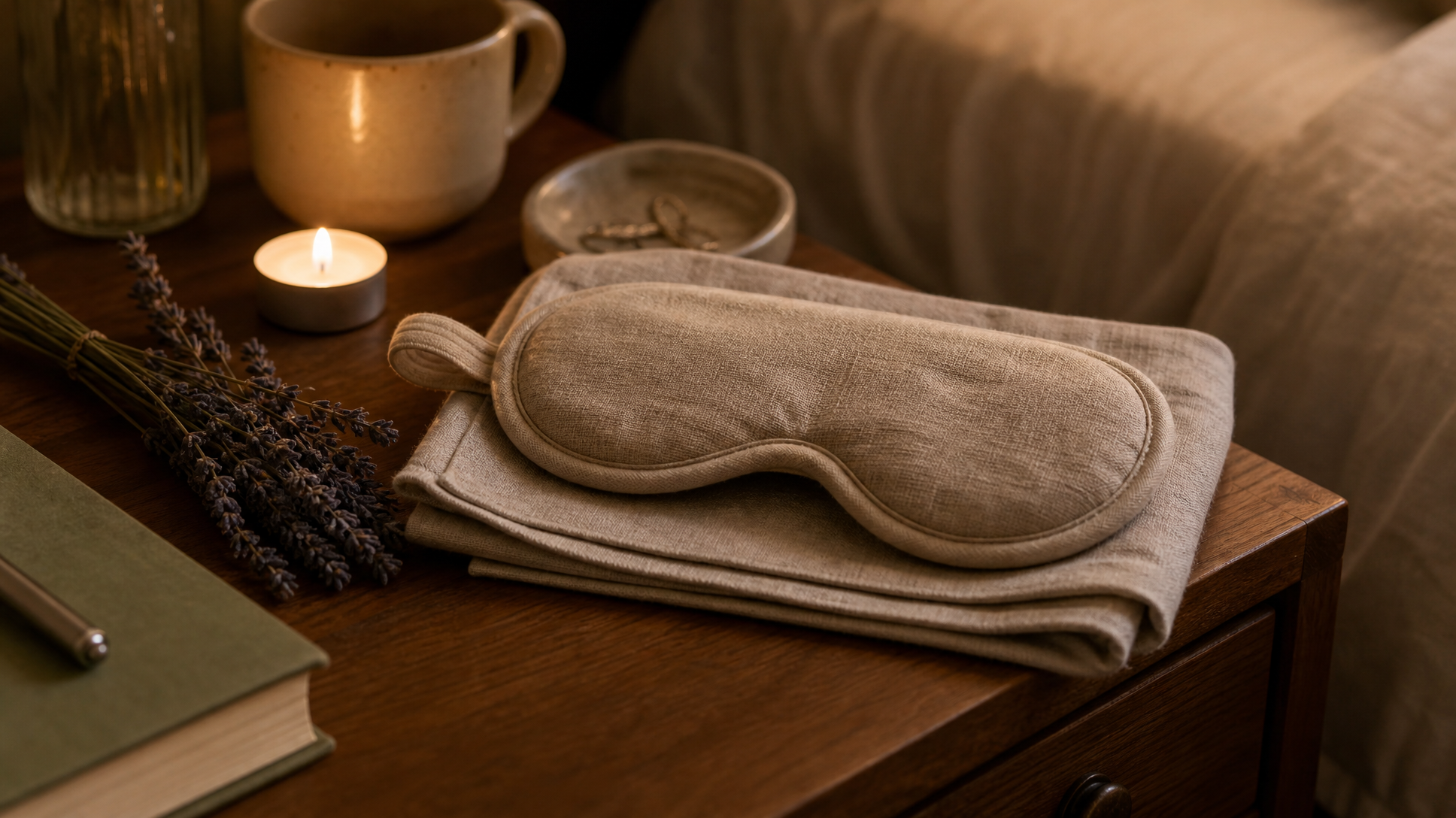
Covering your eyes with something warm and lightly weighted is one of the fastest ways to signal rest. It blocks light, reduces visual stimulation, and the gentle pressure has a grounding effect. If you've ever noticed how quickly you feel calmer when you cover your eyes, that's not a coincidence.
A herbal eye mask or eye pillow — gently warmed or used at room temperature — works well here. Kozi's eye masks and eye pillows are filled with herbal blends that release a soft, calming scent when warmed. You don't need to do anything except place it over your eyes and let it sit. If you want to read more about why eyes tend to feel so spent by this point in the day, this post on why your eyes feel exhausted by evening covers it well.
What to Skip
This is the part most wind-down guides leave out, and it matters as much as what you do.
Skip the long hot shower if you're planning to sleep soon. A short warm shower is fine; a prolonged hot one can actually delay the temperature drop your body needs to initiate sleep.
Skip the 'productive' wind-down tasks. Tidying the kitchen, prepping tomorrow's bag, answering one last email — these aren't relaxing, even if they feel satisfying. They keep your brain in task mode. Save them for morning.
Skip the guilt about not doing more. A wind-down routine doesn't need to be elaborate to work. The nights when you do the bare minimum — warmth, darkness, stillness — are often the nights you sleep best. Complexity is the enemy of consistency.
The Sequence, Kept Simple
Here's what a realistic, low-effort wind-down actually looks like on a depleted night:
- Heat your wrap. Drape it over your neck or shoulders the moment you sit down. Let the warmth and scent do their job.
- Cover your eyes. Use a warm or room-temperature eye mask. Dim the lights or turn them off entirely.
- Put your phone face-down. You don't have to turn it off. Just make it harder to reach for reflexively.
- Stay there for ten minutes. That's the whole routine. If you fall asleep on the couch, that counts.
You're not building a lifestyle. You're just giving your body a consistent off-ramp. Do it enough nights in a row and it starts to work faster — your nervous system learns what the warmth and scent mean, and it begins to respond before you've even fully settled in.
That's the version of a wind-down routine that actually survives contact with a real, tired evening. Explore Kozi's full range of herbal wraps and eye masks and find the one that fits your end-of-day moment — no protocol required.
Frequently Asked Questions
How long should I heat a herbal wrap before using it?
Heating times vary by product and microwave wattage, so always follow the specific instructions included with your wrap. As a general rule, start with a shorter interval, check the temperature against your inner wrist before applying, and add more time in small increments if needed. It should feel comfortably warm — never hot enough to cause discomfort.
Can I use a herbal wrap for cold therapy instead of heat?
Yes — many herbal wraps, including those in Kozi's range, are designed for both warm and cold therapy. For cold use, place the wrap in a sealed bag and chill it in the freezer for the time recommended in the product instructions. Cold therapy can be useful for headaches, inflammation, or when you simply want a cooling, calming sensation rather than warmth.
Is it safe to fall asleep with a herbal eye mask on?
A room-temperature herbal eye pillow or mask is generally fine to drift off with. If you've warmed it, allow it to cool to a comfortable level before using it for sleep — you want it gently warm, not hot, and you shouldn't sleep with any product that retains significant heat directly against your skin for extended periods. When in doubt, check the care and safety instructions that come with your specific product.
What if I'm too tired to even do the four steps above?
Do just one: put something warm on your neck or cover your eyes. The sequence is a suggestion, not a requirement. Even a single physical cue — warmth, weight, scent, darkness — is enough to start shifting your nervous system toward rest. The goal is a consistent signal, not a perfect routine.